return
Knowledge linkage
structures in communication studies
using citation analysis
among communication journals
Scientometrics
(forthcoming)
Han Woo PARK and Loet LEYDESDORFF
< click here for .pdf>
Abstract
This research analyzes a “who cites whom” matrix in terms of aggregated,
journal-journal citations to determine the location of communication studies on
the academic spectrum. Using the Journal of Communication as the
seed journal, the 2006 data in the Journal Citation Reports are used to map
communication studies. The results show that social and experimental psychology
journals are the most frequently used sources of information in this field. In
addition, several journals devoted to the use and effects of media and advertising
are weakly integrated into the larger communication research community, whereas
communication studies are dominated by American journals.
Key words: Knowledge linkage, communication
studies, citation analysis, social network analysis, communication
journals
Introduction
Given the notable institutional build-up of media and communication
studies since 1990, in not only North America but also other regions including
East Asia and Western Europe, the number of manuscripts published in the
Institute for Scientific Information (ISI)-rated journals is increasing rapidly
(the ISI has recently been renamed Thomson-Reuters but the name ISI continues
to be widely used). The conventional perception of communication studies is
that it is an incomplete aggregation of atomized research domains.
Scholars
have viewed communication studies as a heterogeneous group with different
attributes (Delia, 1987; Leydesdorff, 2004), partly due to the duality of
communication studies. As Rogers (1994, p. 48) stressed, “Communication is a
professional field, as well as a scientific discipline. The mass media
industries stand behind the academic field of communication, offering jobs for
its graduates, helping fund its research, and providing endowments for
professors and schools of communication.” As a result, communication studies have
split into many academic entities; for example, speech communication, mass
communication, advertising, and journalism. Continual developments in media
technology have also forced the founding of new specialties that include
telecommunication, new media, computer-mediated communication, informatics, and
human-computer interaction.
In 2005, communication studies gained legitimacy as an independent
discipline for educating and studying the nature of human communication
mediated by various channels (Treadwell, 2006). The National Science Foundation
of the USA (NSF) formally accredited communication studies as an academic field
with a particular subject in the NSF’s list of disciplines. The representative
professional International Communication Association (ICA) was founded more
than half a century ago in 1950. Derek de Solla Price (1963) noted that big
science refers to a field that has established theories, mature research
methods, and scientific collaborations. In this regard, communication studies
are ready to become accepted as a big science in the 2000s.
The success in having communication studies recognized as a stand-alone
discipline inspired us to write this article. We address the following two research
questions: Where on the academic spectrum do communication studies reside? Which
subject category is core to communication studies? In order to investigate
these topics, we focus on linkage structures in communication studies using
citation analysis among communication journals. Citations do not occur in a
social vacuum. What communication researchers cite forms how communication
studies are constituted. More specifically, we evaluate the development and
progress of communication studies by collecting a journal-journal citation matrix
from the ISI’s database as an input file to our scholarly investigation.
Related
studies
Compared to the speedy diffusion of communication and media
studies, scientometric exercises that examine the academic structure of current
communication research have been rare. In response to this, the Journal of
Communication, a top journal published by the largest association of
scholars in communication studies, the ICA, has published two studies that
analyze the national origins of communication journals (Lauf, 2005) and
professional careers of article authors (Bunz, 2005). Both articles look at the
position of communication studies as an independent discipline using bibliometric
data obtained from scholarly journals and their authors. In a similar vein,
Masip (2005) focused on research articles written by European authors in thirty-five
communication journals.
There are more restricted studies
that focus on reviewing some specific area in communication studies: Internet
research related to advertising (Cho & Khang, 2006), research trends in
mass communication (Kamhawi & Weaver, 2003), and media research on the
Internet (Kim & Weaver, 2002).
More recently, the Communication Research Centre (CRC, 2007) at
the University of Helsinki conducted a comprehensive project about current
trends of media and communication research in seven countries (Finland, USA, Germany, France, Japan, Estonia, and Australia). According to the reports about
individual countries, communication studies around the world are somewhat
differently deployed in some major strands. While in the U.S.-based academic
tradition, quantitative investigations of media effects are dominant,
communication programs with different approaches (e.g., humanistic and
sociological practices) are gradually growing. The CRC’s report on the U.S. also provides the top ten communication and media journals using the ISI’s impact
factor from 1998 to 2005. At the top of the top ten list (according to an
eight-year mean) is Public Opinion Quarterly, followed by Communication
Research, and the Journal of Communication. Media Psychology,
Discourse & Society, Human Communication Research, Cyberpsychology & Behavior,
Public Culture, Political Communication, and the Journal of
Health Communication are also included in the top-ten citation list.
These previous studies are limited to individual characteristics
of communication studies. The past literature is unable to discover the
networked traits within communication studies by ignoring structural properties
among communication journals and their neighboring journals in other fields. As
alluded earlier, communication studies as a disciplinary field are made of
several scientific domains. Perhaps, this field can be captured better through network-oriented
indicators and visualizations than by indicators which normalize over the
journals subsumed under the ISI-category of “communication.” The connectivity
patterns represented in the citation behavior of authors in communication studies
journals may reveal how this fragmented community perceives and reconstructs
its relevant scholarly environments.
Methods: Social
network metrics and data collection
Indicators and visualizations based on social network analysis are
used in this research (for a detailed explanation about social network metrics
and technical procedures, see Hanneman & Riddle, 2005). Previous
studies (Kim et al., 2006; Leydesdorff, 2005; Park et al., , 2005; Park &
Thelwall, 2006; Park & Leydesdorff, 2008) have shown that the structural
pattern of citations among a set of authors, articles, or journals can be
better examined using a network perspective. For instance, Freeman (2004)
suggested that a network approach utilizing citation data may be a more robust
means of studying the inside world of an invisible research community. Using
social network techniques, Freeman (2004, pp. 165-166) showed that there were surprisingly
few bridging linkages between physicists and the traditional social network
analysts who cited Milgram (1967)’s famous article entitled “The Small World
Problem”. The network perspective, developed within the social and behavior
sciences, is currently identified as an influential method in library and information
science, and scientometrics (Otte & Rousseau, 2002; Thelwall, 2004, pp.
213-217).
Among the many techniques for gathering network data, snowballing
is frequently used in the case where the entire number of nodes in a given
social system and whether they entertain relations are a priori unclear (Garton
et al., 1997). For example, researchers often get a particular person to list
their acquaintances and report their interactions with all other network
members in terms of face-to-face meeting frequency per week, the type of
communication media used, and the closeness of relationship. Leydesdorff (2007)
took advantage of this network sampling technique to visually map the specific
journal’s relevant citation environment and succeeded in detecting a collection
of journals that make a network having a particular journal as an entrance
point. More recently, Park and Leydesdorff (2008) applied this sampling
technique to a scientometrics exercise by focusing on the cited dimension of a Korean
ISI-listed journal.
The data for this research were harvested from the CD-Rom versions
of the Journal Citation Reports (JCR) 2006. More specifically, the 107 journals
in the 2006 ISI database that cited the Journal of Communication were
taken and an asymmetrical (valued) matrix—that is, a matrix in which the
frequencies of citations between journals are provided—was constructed for
social network analysis. Next, ISI’s subject categories and publication places
of individual journals listed in the sample were collected. Additionally, the journals
cited in the Journal of Communication were gathered and a citation matrix
among these (154) journals was made. However, our analysis focuses on
the domain of 107 journals in the citation impact environment. Aggregated
citation data and journal names for these journals are provided in Appendix I.
All values in the JCR-data refer to unique citation relations at the article
level.
The Journal of Communication was selected as the focal
journal for the mapping of communication studies because, as signaled in its
title, this Journal is a flagship publication in the communications research
community. The ICA, the world’s largest scholarly body in terms of the
participatory countries, has an institutional responsibility for the Journal.
Compared to the ICA’s other titles (e.g., Communication Theory, Human
Communication Research, and Journal of Computer-Mediated Communication),
the Journal is relatively open to many studies with varied theoretical and
methodological backgrounds. Most articles published in Human Communication
Research, for example, seem to contain a purely quantitative analysis. Therefore,
studying the journal structure of communication studies as a discipline with
the Journal of Communication as an exemplar is probably the best approach,
although this is indeed a specialist universe of publications.
UciNet for Windows (Borgatti et al., 2002), a commonly used
software program for network analysis, was used to calculate the various metrics
and NetDraw packaged with UciNet was used for the graphic illustrations. In
social network research, visualization is often an informative tool to reveal
the relationship between different network nodes, in this case, journals. NetMiner
software (Cyram, 2003) was also used for the visualizations.
Results
Citation
structure among 107 journals citing the Journal of Communication
The Journal of Communication was cited by 107 journals in
2006. The network analysis of the 107 * 107 citation matrix reveals that the clustering
coefficient of this network is 0.59. The clustering coefficient—defined as the
proportion of links between the vertices within the neighbourhood of a vertex divided
by the number of links that could possibly exist between all these vertices—indicates
the
degree to which friends of a person know each other (for a mathematical
definition, see Watts, 1999). In this research, the clustering coefficient
measures the extent to which a journal’s neighboring journals are connected to one
another. Averaging these proportions over all journals in the network shows how
closely interconnected neighbors in the network are. Interestingly, the coefficient
value (0.59) found in the study is very close to the result (0.56) that network
physicists have identified in social networks of scientific collaboration (Barabási,
2002).
The diameter value of 5.00 implies that all journals are connected
to the extent of five hops when the direction of the citations is not
considered. The mean distance is 2.08. That is, if two journals in the network are
selected they are on average about two steps away from each other. Reciprocity
is 0.55: more than half of all the journals exchange their citations. For
example, the authors of journal A chose the articles published in journal B as
their references and so did the journal B’s authors with reference to journal A.
All of these network metrics (of course, with the exception of reciprocity) were
done after binarization and symmetrization.
More specifically, the Psychological Bulletin is the journal
most cited by others (1,524 times) in this network. Conversely, the Journal
of Communication was cited 781 times. In network analysis, “indegree
centrality” refers to the total number of citations a journal receives from the
other journals at the article level and “outdegree centrality” measures how
many times a journal cites the articles published in other journals in the same
network (Freeman, 1979). For the calculations of both these centrality measures,
within-journal self citations were excluded.
Degree centrality measures are primary indicators for the selected
node’s network activity. The dominance of the Psychological Bulletin in
terms of the being-cited dimension, that is, indegree centrality, means that
research articles in communication science journals connected to the Journal
of Communication provide references mainly to psychology and its related
concepts. As Delia (1987, p. 23) stated, the most influential sources for the
construction of communication research come from theoretical concepts and methodological
behaviorism in psychology, and the quantitative research orientation in
sociology and political science, that is, those specialties among the social
sciences in which issues of measurement and operational procedures are of
central concern.
In the citing dimension, Psychological Bulletin had a
relatively small number of citations which make reference to 267 articles
published in 23 other journals in the network. The most central journal in the
citing dimension is Sex Roles with 813 citations to 46 other journals, followed
by Social Science & Medicine, the Journal of Youth &
Adolescence, and the Journal of Communication with 635, 542, and 512
citations, respectively. The difference between these highest numbers in the cited
and citing dimensions are reflected in the network centralization metrics. The
outdegree network centralization (citing dimension) is 32.73 percent while the indegree
centralization (cited dimension) is 85.11 percent. The higher this percentage
the more centralized a network is. Therefore, these 107 journals are connected
to each other in the cited network more than in the citing network. In the
dominant dimension (cited), the Psychological Bulletin is the most
central source of citations.
Table 1 lists the most highly and the most rarely cited ten
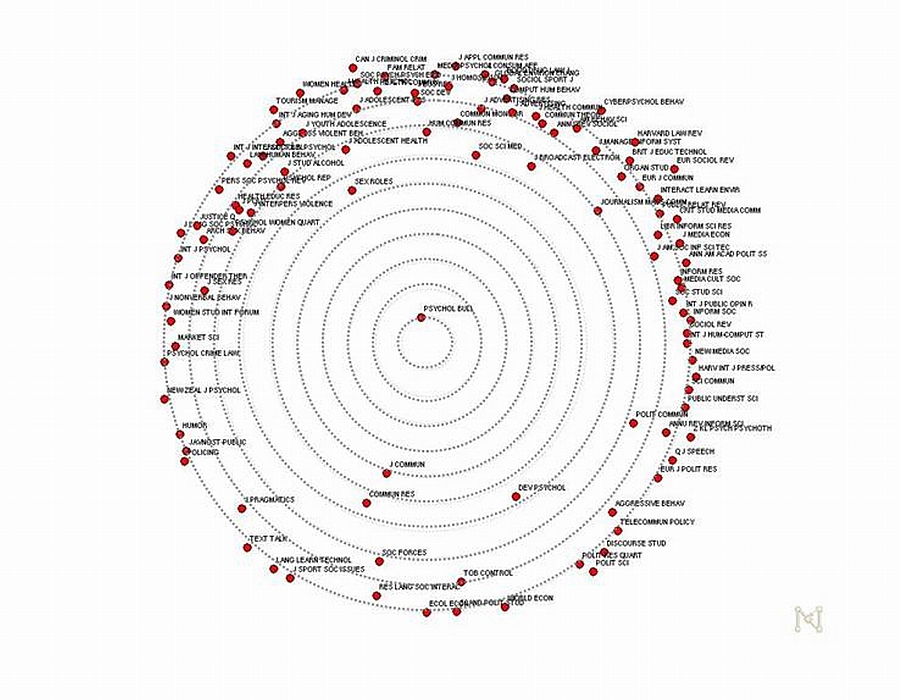
journals with their respective citation counts. Figure 1 illustrates the 107
journals according to their indegrees, that is, times cited in the network. The
most highly cited Psychological Bulletin occupies the central
position of the target board and the next most frequently cited journals are
assorted up and down. The remaining journals are scattered around the target.
Table 1. The most highly and most rarely cited journals in a network
using the Journal of Communication as the seed journal
|
Highly
cited
ten journals
|
Indegree
(times
cited)
|
Least
cited
ten journals
|
Indegree
(times
cited)
|
|
PsycholBull
|
1524
|
NewZealJPsychol
|
9
|
|
DevPsychol
|
848
|
BritJEducTechnol
|
7
|
|
JCommun
|
781
|
InteractLearnEnvir
|
5
|
|
CommunRes
|
674
|
WorldEcon
|
4
|
|
SocSciMed
|
623
|
Policing
|
3
|
|
SexRoles
|
552
|
ZKlPsychPsychoth
|
2
|
|
PsycholRep
|
388
|
FoodDrugLawJ
|
0
|
|
HumCommunRes
|
386
|
LangLearnTechnol
|
0
|
|
PsycholWomenQuart
|
362
|
PolitSci
|
0
|
|
JBroadcastElectron
|
351
|
TextTalk
|
0
|
·
The abbreviations used for the journal titles are available at
http://images.isiknowledge.com/help/WOS/A_abrvjt.html.
(See also Appendix I.)
Figure 1. Indegree distributions of the 107 journals under study.
l
The data used for this Figure were logarithmically scaled.
Additionally,
the inter-citation matrix among 107 journals was aggregated according to the
disciplinary categories listed in the ISI’s database. Despite the debate about the
ISI classification system (Boyack et al., 2005; Leydesdorff, 2006), this
perspective can be complimentary to the above findings. The 107 journals belonged
to a total of 21 subject categories. The majority of journals is classified as
“communication” (28 journals) or “psychology” (24 journals), followed by
“Criminology & Penology” (7 journals) and “Business” (7 journals).
“Information Science & Library Science”, “Political Science”, and
“Sociology” are included with six journals. Nine categories contain only a
single journal each.
According to the network analysis results (see Table 2), 24
journals belonging to “psychology” as a block were cited 2,260 times outside
the psychology domain and 28 “communication” journals were cited 1,418 times by
journals of other groups. The next most cited categories are “public, environmental
& occupational health” (3 journals, 755 being cited) and “sociology” (6
journals, 555 being cited). Furthermore, the most preferred category by “communication”
journals was “psychology” journals (565 citations). Conversely, “communication”
journals were cited 487 times by “psychology” journals. This tells us that the relational
strength between the two fields—“communication” and “psychology”—is the highest
among all other subject pairs.
Furthermore, this so-called (conventional) block-analysis allows
the researcher to identify the extent to which the communication journals under
investigation cite within their own group compared to how often they cite and
are cited outside of this group. This can be done through another frequently
used network metric, “density,” that is, the ratio of the number of observed
citations relations between journals compared to the number of possible
citation relations [total cells or (N * N -1)]. The communication studies
network is then considered as a valued graph. Thus, the density is calculated
as the sum of the values of the observed citations between journals divided by
the number of cells in the matrix. The density of “communication” journals is 3.64
(2,755 self-citations / (28 * 27 =) 756 possible citation relations) and of “psychology”
journals is 7.15 (3,945 self-citations / (24 * 23 =) 552 possible citation
relations). According to these density metrics, the communication network is sparser
than the psychology network. The average strength of citations thus reveals
that communication studies are not yet an independent inter-reading community
(Van den Besselaar & Leydesdorff, 1996).
Citation
patterns among eight core journals cited by the Journal of Communication
The analysis of citation patterns of the Journal of Communication
and its relevant journals provides significant evidence that the authors in the
seed journal, the Journal of Communication, do not tend to reach out to
a broader literature beyond psychology. Eight journals were identified from a
list of 158 journals that were cited by the Journal of Communication in
2006. These eight journals contribute above the threshold level of two percent of
the total references in the Journal of Communication.
Table 3 summarizes the inter-citation frequency patterns between
these journals. The left-side list of most cited journals confirms that
communication scientists within the citation environment of the Journal of
Communication are inclined to cite from journals in social and experimental
psychology. Two prestigious journals in psychology, the Personality & Social
Psychology Bulletin and Journal of Personality & Social Psychology were
central in indegree (times cited) and outdegree values (times citing) among the
journals cited by authors in the Journal of Communication. Note that
these two journals were not included in Appendix I; articles in these journals
did not cite articles in the Journal of Communication in 2006.
Conversely, the Psychological Bulletin is not on this list; more
specialist journals in social and experimental psychology are cited.
Table 3. Degree distributions of eight core journals
|
Journals
|
Indegree
(times
cited by)
|
Journals
|
Outdegree
(times
citing to)
|
|
PersSocPsycholB
|
1193
|
JPersSocPsychol
|
1589
|
|
JCommun
|
422
|
PersSocPsycholB
|
479
|
|
JPersSocPsychol
|
409
|
CommunRes
|
187
|
|
CommunRes
|
193
|
HumCommunRes
|
120
|
|
HealthPsychol
|
192
|
HealthPsychol
|
117
|
|
HumCommunRes
|
158
|
AmJPublicHealth
|
89
|
|
JBroadcastElectron
|
119
|
JBroadcastElectron
|
75
|
|
AmJPublicHealth
|
45
|
JCommun
|
75
|
Citation
patterns among 22 core journals citing the Journal of Communication
To
closely examine the relevant citation environment generated by the Journal
of Communication, we selected the 22 journals that cited this seed journal,
the Journal of Communication, in 2006, above the same two percent
threshold. Twenty-two journals cite the Journal of Communication to the
extent of more than two percent of the total number of received citations.
Table 4 clearly shows the key players in the communications field.
Communication Research was cited 525 times followed by Journal of
Communication (465 times). In the citing dimension, the Communication Research
and the Journal of Communication cited the Journal of Communication 190
and 340 times, respectively. Communication Research cites other journals
including itself less often than the Journal of Communication, which
raises the question of what causes this journal to be cited so frequently? Although
there is an effect of the smaller number of articles published in Communication
Research (26 against 53 in the Journal of Communication), the main
reason is that Communication Research is printed and distributed by a
commercial publishing house (Sage), while the Journal of Communication is
an official journal of the scholarly association (ICA). Thus, we assume that
citation practices in these two journals might have been affected by different selection
processes of managing editors and other diffusion channels.
Surprisingly, while the authors of the Javnost/The Public—a
Slovenian journal published by the Faculty of Social Sciences in Ljubljana—cited
36 research papers published in journals belonging to this network, it was not
cited at all by any of the 21 other journals. A leading European journal, the European
Journal of Communication, was cited only 39 times. Furthermore,
interdisciplinary journals (e.g., Harvard International Journal of Press/Politics,
New Media & Society, Annals of the American Academy of Political &
Social Science, Science Communication, and Information Research) were
less used as sources for references than traditional communication journals.
Table 4. Degree distributions of core journals in the citation network of
the Journal of Communication
|
Journals
|
Indegree
(times
cited)
|
Journals
|
Outdegree
(times citing)
|
|
CommunRes
|
525
|
JCommun
|
340
|
|
JCommun
|
465
|
JournalismMassComm
|
303
|
|
JBroadcastElectron
|
285
|
CommunRes
|
190
|
|
HumCommunRes
|
281
|
HealthCommun
|
187
|
|
PolitCommun
|
202
|
JBroadcastElectron
|
177
|
|
CommunMonogr
|
179
|
JHealthCommun
|
163
|
|
JournalismMassComm
|
157
|
MediaPsychol
|
151
|
|
HealthCommun
|
97
|
AmBehavSci
|
144
|
|
JHealthCommun
|
74
|
HarvIntJPress/pol
|
137
|
|
CommunTheor
|
73
|
HumCommunRes
|
125
|
|
JAdvertising
|
72
|
CommunMonogr
|
124
|
|
IntJPublicOpinR
|
63
|
CommunTheor
|
110
|
|
SexRoles
|
62
|
IntJPublicOpinR
|
107
|
|
AmBehavSci
|
61
|
NewMediaSoc
|
104
|
|
MediaPsychol
|
54
|
JAdvertising
|
94
|
|
EurJCommun
|
39
|
SexRoles
|
79
|
|
HarvIntJPress/pol
|
30
|
PolitCommun
|
76
|
|
NewMediaSoc
|
29
|
EurJCommun
|
42
|
|
AnnAmAcadPolitSs
|
21
|
JavnostPublic
|
36
|
|
SciCommun
|
10
|
SciCommun
|
36
|
|
InformRes
|
0
|
AnnAmAcadPolitSs
|
35
|
|
JavnostPublic
|
0
|
InformRes
|
19
|
Figure 2 provides an illustration of the center-periphery
structure in this network. The thickness of lines between journals at the nodes
is proportional to their inter-citation frequencies. In other words, the width of
the lines between journals can be considered as the communication strength
among authors who publish their research in the particular journals. The arrow
head means the direction of citation. The majority of journals in the network
are strongly connected to the journals (e.g., Communication Research, Journal
of Communication) that would fall into the categories of American
scholarship and social-psychology oriented research traditions.
However, European and interdisciplinary journals tend to appear at
the margins on both sides of the network diagram. For example, the Journal
of Advertising is a preferred journal among communication scientists as
well as business scholars majoring in marketing. Political Communication is
a joint publication of the ICA and the American Political Science Association. Science
Communication publishes research related to public understanding of science
that is one of the key areas in science study.
Figure 2. Network diagram of 22 journals in the core of the citation network
of the Journal of Communication.

Table 5. The citation matrix of 22 journals in the core of the citation
network of the Journal of Communication.
|
AmBehavSci
|
|
3
|
13
|
11
|
2
|
|
6
|
3
|
6
|
|
2
|
5
|
16
|
15
|
6
|
|
10
|
|
7
|
26
|
|
13
|
|
AnnAmAcadPolitSs
|
|
|
|
4
|
2
|
5
|
|
|
|
|
8
|
|
|
12
|
|
|
|
|
|
4
|
|
|
|
CommunMonogr
|
|
|
|
23
|
11
|
|
2
|
6
|
32
|
|
|
|
10
|
26
|
2
|
|
|
6
|
|
3
|
3
|
|
|
CommunRes
|
|
|
29
|
|
5
|
3
|
3
|
4
|
55
|
|
3
|
|
25
|
18
|
|
|
11
|
5
|
|
19
|
|
10
|
|
CommunTheor
|
|
2
|
15
|
27
|
|
|
|
|
21
|
|
2
|
2
|
11
|
13
|
4
|
|
3
|
3
|
|
|
|
7
|
|
EurJCommun
|
|
|
|
8
|
|
|
|
|
2
|
|
|
|
6
|
12
|
|
|
4
|
|
2
|
8
|
|
|
|
HarvIntJPress/pol
|
3
|
4
|
|
20
|
|
3
|
|
|
7
|
|
2
|
4
|
10
|
27
|
|
|
14
|
|
|
41
|
2
|
|
|
HealthCommun
|
7
|
|
40
|
15
|
13
|
|
|
|
25
|
|
|
7
|
10
|
26
|
37
|
|
7
|
|
|
|
|
|
|
HumCommunRes
|
3
|
|
30
|
51
|
5
|
|
|
5
|
|
|
|
2
|
5
|
12
|
2
|
|
4
|
|
|
4
|
|
2
|
|
InformRes
|
|
|
|
|
|
|
|
|
|
|
|
|
7
|
12
|
|
|
|
|
|
|
|
|
|
IntJPublicOpinR
|
|
4
|
|
31
|
|
4
|
2
|
|
5
|
|
|
2
|
3
|
27
|
|
|
14
|
|
|
15
|
|
|
|
JAdvertising
|
2
|
|
4
|
15
|
3
|
|
|
|
8
|
|
5
|
|
18
|
20
|
|
|
5
|
5
|
2
|
|
|
7
|
|
JBroadcastElectron
|
2
|
|
4
|
36
|
4
|
2
|
4
|
|
21
|
|
7
|
4
|
|
45
|
5
|
|
22
|
7
|
3
|
11
|
|
|
|
JCommun
|
6
|
2
|
18
|
93
|
13
|
5
|
2
|
12
|
37
|
|
12
|
14
|
45
|
|
11
|
|
16
|
18
|
3
|
29
|
|
4
|
|
JHealthCommun
|
2
|
|
6
|
20
|
8
|
|
2
|
59
|
11
|
|
|
5
|
5
|
18
|
|
|
13
|
|
|
2
|
3
|
9
|
|
JavnostPublic
|
|
|
2
|
|
3
|
4
|
|
|
7
|
|
|
|
|
11
|
|
|
|
|
5
|
4
|
|
|
|
JournalismMassComm
|
6
|
4
|
7
|
71
|
|
6
|
7
|
2
|
16
|
|
14
|
16
|
29
|
68
|
5
|
|
|
5
|
7
|
34
|
|
6
|
|
MediaPsychol
|
4
|
|
3
|
48
|
4
|
|
|
4
|
17
|
|
|
4
|
33
|
26
|
2
|
|
2
|
|
|
|
|
4
|
|
NewMediaSoc
|
9
|
2
|
|
15
|
|
3
|
|
|
6
|
|
|
4
|
32
|
15
|
|
|
14
|
|
|
2
|
2
|
|
|
PolitCommun
|
2
|
|
3
|
16
|
|
4
|
2
|
|
2
|
|
4
|
|
4
|
28
|
|
|
11
|
|
|
|
|
|
|
SciCommun
|
2
|
|
2
|
10
|
|
|
|
2
|
|
|
4
|
|
|
11
|
|
|
5
|
|
|
|
|
|
|
SexRoles
|
13
|
|
3
|
11
|
|
|
|
|
3
|
|
|
3
|
16
|
23
|
|
|
2
|
5
|
|
|
|
|
Subgroup
structures among the 107 journals citing the Journal of
Communication in 2006
In
the above section, the individual position of each journal in the network was detected in
terms of citation relations and then the structure among the core journals was
identified using a traditional threshold routine. This section employs techniques
from social network analysis that can be used to examine the sub-structures of a
network, based on both the direct and indirect citation relations among
journals. “Component analysis” enables the researcher to identify where an
entire network is divided (Hanneman & Riddle, 2005).
The
network of 107 journals under investigation is one component because the journals
were selected on the criterion that they cited the Journal of Communication.
In this case, component analysis for valued network can be used to examine the
hierarchy among the components. The resulting dendrogram can be used to
separate components. A hierarchical dendrogram, or a tree diagram, can be used
to illustrate the arrangement of the sub-groups. The distinction between
components is then made according to a cut-off value. In this research, a cut-off
value of 22 was assumed because sub-groups clearly emerged at this level. Due
to space limitation, the dendrogram is not printed here and only the resulting components
are described.
The overall structure of the network appeared to have one large
component with relatively tight couplings among journals and several minor
components. Special attention is placed on the largest component and its sub-component
parts because all major communication journals belong to this component. Forty-two
journals are connected within this component. This major component can be again
dissected into three primary sectors: general psychology, health-related
psychology, and communication research. This finding confirms that the
underlying structure of communication study is strongly integrated with social
and experimental psychology.
Table 4. Three primary groups in the largest component
|
Groups
|
Journals
|
|
General
psychology
|
AggressiveBehav,
JAdolescentHealth, PsycholBull, TobControl
DevPsychol,
JAdolescentRes, JHealthPsychol, JSocClinPsychol, JYouthAdolescence,
PersSocPsycholRev, PsycholRep, PsycholWomenQuart, SexRoles, SocDev,
SocPsychPsychEpid, SocSciMed, WomenHealth
|
|
Health-related
psychology
|
JStudAlcohol,
AggressViolentBeh, AnnuRevSociol, ArchSexBehav, CommunMonogr, HealthCommun, HealthEducRes,
JHealthCommun, JHomosexual, JInterpersViolence, JSexRes, SocForces
|
|
Communication
research
|
AmBehavSci,
CommunRes, CommunTheor, HarvIntJPress/pol, HumCommunRes, IntJOffenderTher,
IntJPublicOpinR, JBroadcastElectron, JCommun, JournalismMassComm,
MediaPsychol, NewMediaSoc, PolitCommun
|
In the remaining component hierarchy, interesting smaller units
were found. For example, five marketing communication journals (Journal
of Advertising, Journal of Advertising Research, Journal of Business Research,
Marketing Science, Tourism Management) constitute one sub-group.
Information science journals also form a single group: Annual Review of Information
Science & Technology, Journal of American Society for Information Science
& Technology, Information Research, Library & Information Science Research,
International Journal of Human-Computer Studies, Journal of Management Information
Systems, Computers in Human Behavior, and Cyberpsychology & Behavior.
There is another group of political science journals (Journal of Polity,
Political Research Quarterly) and a legal studies-related component (Law
& Human Behavior, Psychology Crime & Law, Organization Studies, Sociological
Review).
Six journals are isolates, that is, not connected to any other
journals in the network. Four of these isolates (Food & Drug Law Journal,
Language Learning & Technology, Political Science, and Text & Talk)
did not receive any citations from any other journal in the network. Additionally,
“bi-component” analysis was used to find the so-called, key weak node in a
network (Hanneman & Riddle, 2005). If the Journal of Communication were
removed, Language Learning & Technology would become completely
isolated in the network. Compared to the other three isolates, Language Learning
& Technology did not have any citation in either the cited or citing
dimensions.
Discussion
In
this research, we found that the impact of social and experimental psychology
journals on communication studies is so large that they can be considered as a major
source of theories and methods for the authors in communication journals.
Communication researchers have tended to employ social psychology literature as
a reference frame. This accords with Roger’s (1994) statement in his book entitled
“A History of Communication Study” that the major intellectual force behind the
emergence of communication studies is social psychology (p. 491). The dominant
perspective of communication scholarship is empirical and quantitative with a
strong focus on determining the effects of communication. The dependent character
of communication studies on social and experimental psychology was clearly
shown by this citation analysis at the level of journals.
The underlying structure identified from the component analysis
gives strong support to the notion that communication studies are overwhelmingly
influenced by literature from social and experimental psychology, and to a much
smaller extent by literature in political science. We found one large cluster
made up of social psychology and mainstream communication journals. However,
network analysis enabled us to discern small clusters that have emerged as independent
specialties within this context. In the case of advertising research, its
intellectual background also comes from theories and methods in social
psychology, but it is currently institutionalized as a stand-alone school in a
number of universities. The University of Illinois at Urbana-Champaign
established the Department of Advertising in 1949. This was the first such
academic department in the America. However, several universities, for example,
the University of Texas at Austin and Michigan State University at East Lansing, have started recently to treat advertising as another
scholarly unit. New media studies seem to follow similar paths. We suggest that
this movement toward diversification within communication studies may result in
a further fragmentation in the structural patterns of relations among social
psychology and communication journals. However, the findings of this research did
not reflect an incremental development of knowledge at the core of the field of
communication studies itself.
One can argue that this could be a consequence of choosing the Journal
of Communication as a seed journal. What if we used another journal as our focal
node? Might we have found more political science in the background? The answer
is yes and no. As voiced in a preliminary analysis based on the 2004 ISI data (Leydesdorff
& Park, 2006), the field of communication studies is insufficiently
codified in theoretical terms to stand alone in terms of its intellectual
traditions and resources. In a genealogical network, children having the same
biological parents have biological affinity. In a similar way, scientists who
were trained and influenced by the same advisors with the authors of articles
in the Journal of Communication are more likely to adopt and share
knowledge in psychology and political science. Probably communication
scholarship is not mature enough to split into more coherent sub-networks that
appear to be integrated among themselves. It seems unlikely that any other
intellectual paradigm will replace the dominant psychology tradition in the
near future.
Journals which can be considered as European in terms of their publishing
houses and affiliations of members of the editorial board had weak network
connectivity with other journals when compared to US-affiliated journals. For
example, the Javnost/The Public cited 36 research papers published in
the 107 journals belonging to the network drawn from the Journal of
Communication, but it was not cited at all by the other journals. According
to Lauf’s (2005, p. 146) national diversity scores in articles published
between 1998 and 2002 in the ISI set of communication journals, the Javnost/The
Public was the next most internationalized (.95 out of 1.00), after Discourse
& Society (.96). Another leading European journal, the European
Journal of Communication, occupied the 9th position (.80) on
Lauf’s ranking list, but we found that it was a relatively infrequently cited
journal. The address of the publishing and editorial houses may not tell us
much about the character of a journal, because this market is internationalized.
Nonetheless, as Lauf (2005) points out, geographical location can be expected
to help deepen the intensity of linkage structures among journals in neighboring
regions and provide prospective authors with better accessibility for
subscription, submission, and citation.
The examination of “self-citations within a journal” provided another
interesting conclusion. While the cited and citing numbers show inter-journal
traffic, these self-citations are the number of citations made to the articles published
in the journal from articles in the same journal. Thus, this can reveal the
specific journal’s internal cohesion among current and prospective authors. The
self-citations in European journals only loosely linked with influential US communication journals are extremely low. For instance, Javnost/The Public and the
European Journal of Communication had two and thirteen self-citations, respectively.
This means that communication scholars publishing in these journals seem to
perceive themselves as marginal sources to acquire relevant information for
their research.
Overall, the application of this citation-based, research design has
not provided more finely grained and qualitative information about structural
relationships within communication studies. In a well-written and concise
overview, Contractor (1996, pp. 110-112) classified communication studies into two
approaches: one focusing on the various situational contexts in which
communication may occur (e.g., interpersonal communication, organization
communication, mass communication, cross-cultural communication, health
communication, and technologically mediated communication), and the other on various
functions of communication including persuasion, socialization, and conflict
resolution. Whatever categories communication scientists label themselves,
their theoretical, methodological and empirical backgrounds are largely attributable
to the literature in social psychology. As Contractor emphasized, as the study
of communication moves into the twenty-first century, three major paradigmatic
alternatives (the systems perspective, based on network analysis among a
social system’s components; the interpretive perspective, underscoring
the meaning of messages uncovered by the receiver; and the critical
perspective, concerned with social reality in relation to the power
relation) will slowly emerge in addition to the earlier psychology-dominated
approach. However, this now more than ten-year old vision remains speculative
without data that show these emerging developments in communication studies.
Acknowledgements
An earlier
version of this paper was presented to the conference of the KSJCS (Korean
Society of Journalism and Communication Studies), 24-26 April 2008, Jeju Island, South Korea. http://www.ksjcs.or.kr/english/english_ksjcs.html
. This
research was supported by YeungNam University research grants in 2008.
return
References
Bunz, U. 2005. Publish or perish: A limited author analysis of ICA and NCA journals. Journal of Communication, 55(4): 703-720.
Barabási, A. L. (2002). Linked: The new science of networks. Cambridge, Massachusetts: Perseus Publishing.
Borgatti, S.P., Everett, M.G. and Freeman, L.C. (2002). Ucinet
for Windows: Software for Social Network Analysis. Harvard, MA: Analytic Technologies.
Boyack, K. W., Klavans, R., & Börner, K. (2005). Mapping the
Backbone of Science. Scientometrics, 64(3), 351-374.
Cho, C., & Khang, H. (2006). The state of internet-related
research in communications, marketing, and advertising: 1994-2003. The Journal
of Advertising, 35 (3), 143-163.
Contractor, N. S. (1996). Communications. In Kuper, A., &
Kuper, J. (eds). The Social Science Encyclopedia. London: Routledge. pp.
110-112.
Cyram (2003). NetMiner User Manual. Seoul: Cyram.
Communication Research Centre (CRC, 2007). Mapping communication
and media research. Retrieved September 19, 2007 from the World Wide Web: http://www.valt.helsinki.fi/blogs/crc/en/mapping.htm
Delia, J. G. (1987). Communication Research: A History. In. C. R. Berger
and S. H. Chaffee. Handbook of Communication Science, pp. 20-98.
Freeman, L. (2004). The development of social network analysis: A
study of the sociology of science. Vancouver: Empirical Press.
Freeman L C (1979). Centrality in Social Networks:
Conceptual clarification, Social Networks 1, 215-239.
Garton, L., Haythornthwaite, C., & Wellman, B. (1997).
Studying online social networks. Journal of Computer-Mediated Communication,
3(1). Retrieved September 19, 2000 from the World Wide Web:
http://www.ascusc.org/jcmc/vol3/issue1/garton.htm
Hanneman, R. A., & Riddle, M. (2005). Introduction to
social network methods. Retrieved February 20, 2006, from http://faculty.ucr.edu/~hanneman/.
Kamhawi, R., & Weaver, D. (2003). Mass communication research
trends from 1980 to 1999. Journalism & Mass Communication Quarterly, 80
(1), 7-27.
Kim, H., Park, H. W., & Thelwall, M. (2006). Comparing
academic hyperlink structures with journal publishing in Korea: A social network analysis. Science Communication, 27 (4), 540-564.
Kim, S. T., & Weaver, D. (2002). Communication research about
the Internet: A thematic meta analysis. New Media & Society, 4(4), 518-538.
Lauf, E. 2005. National Diversity of Major Journals in the Field
of Communication. Journal of Communication, 55(1): 139-151.
Leydesdorff, L. (2004). Top-Down Decomposition of the Journal
Citation Report of the Social Science Citation Index: Graph- and
Factor-Analytical Approaches. Scientometrics, 60(2), 159-180.
Leydesdorff, L. (2006). Can Scientific Journals be Classified in
Terms of Aggregated Journal-Journal Citation Relations using the Journal
Citation Reports? Journal of the American Society for Information Science
& Technology, 57(5), 601-613.
Leydesdorff, L. (2007). Visualization of the citation impact
environments of scientific journals: An online mapping exercise. Journal of the
American Society for Information Science and Technology, 58 (1), 25-38.
Leydesdorff, L., & Park, H. W. (2006). The Journal of
Communication and the Field of Communication Studies: Mapping Scientific
Communication Online. Paper presented at the 56th Annual Conference of the
International Communication. Association (ICA), Dresden, Germany, 10-23 June 2006. [Retrieved September 19, 2007 from the World Wide Web: http://www.leydesdorff.net/communicationstudies/index.htm.]
Milgram, S. (1967), 'The small world problem', Psychology Today, 1
(1): 60-67.
Otte, E., & Rousseau, R. (2002). Social network analysis: a
powerful strategy, also for the information sciences. Journal of Information
Science, 28(6), 441-453.
Park, H. W., & Leydesdorff. L. (2008). Korean journals in the
Science Citation Index: What do they reveal about the intellectual structure of
S&T in Korea?. Scientometrics. 75 (3), 439-462.
Park, H. W., Hong, H. D., & Leydesdorff, L. (2005). A
comparison of the knowledge-based innovation systems in the economies of South
Korea and The Netherlands using triple helix indicators. Scientometrics, 65(1),
3-27.
Park. H. W., & Thelwall, M. (2006). Web science communication
in the age of globalization. New Media & Society. 8(4). 629-650.
Price, D. J. de Solla 1963. Big Science, Little Science and
Beyond. New York: Columbia University Press.
Rogers, E. M. (1994). A history of communication study: A
biography approach. New York: The Free Press.
Thelwall, M. (2004). Link Analysis: An Information Science
Approach. San Diego: Academic Press.
Treadwell, D. F. (2006). Situating communication studies: A study
in academic boundaries. Journal of Human Subjectivity. 4 (2), 2006.
95-116.
Van den Besselaar, P., & Leydesdorff, L. (1996). Mapping
Change in Scientific Specialties: A Scientometric Reconstruction of the
Development of Artificial Intelligence. Journal of the American Society for
Information Science, 47, 415-436.
Watts, D. J. (1999).
Small worlds. Princeton: Princeton University Press.
return
